Showing posts with label Foodie Fridays. Show all posts

Friday, November 24, 2017

Cooking Casebook: Beef short ribs with pasta


We've been living like nomads since the start of our home renovations, and have been staying either with my parents in SG, or with the in-laws over in Penang. Whatever the case, I know I miss home, and the kids do too. I also miss having our own simple home-cooked meals (though not so much the slaving over the hot stove!), and I can't wait to take out my pots and pans when the dust from the reno has settled (literally!).

Anyway, speaking of cooking, this recipe for beef short ribs is one of my favourite recipes to cook if we want a simple pasta meal, that is yet elegant enough to serve for guests. It's really fuss-free to prepare, tastes great, and best of all, is freezer friendly! It was a modification of this recipe, and I use my Le Creuset French oven in this case, as I find it brings out the flavours better than the slow-cooker.

BEEF SHORT RIBS WITH PASTA
(serves 8-10)


Ingredients
1.5 kg of beef short ribs 
2 tbsp olive oil 
4 tbsp of butter
1/2 cup of red wine
2 cans of whole, peeled tomatoes
3/4 cup of sun-dried tomatoes (those that are stored in oil)
1 small can of tomato paste 
1 large onion, diced
5 cloves of garlic, minced
2 large carrots, cut into thick slices
2 tsp dried basil
2 tsp dried parsley
1 tsp oregano
1/2 tsp dried thyme
1/2 tsp crushed red pepper (optional)
4 tbsp freshly grated parmesan cheese
2 tbsp shredded fresh basil leaves
Salt and pepper
Pasta for serving (we use papardelle)


Method
1. Add and heat the olive oil in a cast iron pot (we use a round, 26cm Le Creuset French oven) over medium-high heat. 

2. Season the ribs with salt and pepper, and add them to the pot. Sear the ribs all over, taking about 1 minute per side.

3. Add the butter, taking care not to let the butter burn.

4. After butter has melted and starts to froth, add the garlic and onions, and brown them for a few minutes. 

5. Add the red wine, tomatoes, sun-dried tomatoes (drain away the oil that they are stored in first), tomato paste and the dried herbs. Cover and cook for 4 hours on low heat, stirring occasionally. 

6. Add and stir in the carrot slices, and cook for an additional hour. If the sauce appears too dilute, remove the lid during the last hour of cooking. (Leave the lid on if the sauce is the right thickness, and add a splash of water if you feel the sauce is too thick.) 

7.  After 5 hours of cooking (you can cook it even longer if you wish), remove the pot from heat, shred the meat and remove the rib bones. Stir in the parmesan cheese and fresh basil. Season with more salt and pepper if necessary.

8. Cook pasta until al dente, and drain. Serve the sauce with the pasta. (This sauce goes amazingly well with pappardelle!)


Tips
1. Beef short ribs can be rather pricey, so we buy the frozen ones from the wet market, as they are relatively cheaper.

2. You can replicate this recipe in the slow-cooker, just that it is more troublesome, since you would need to sear the ribs in a pot before putting them into the slow-cooker. I also find that the flavours develop more if you use the French oven instead of the slow-cooker.


PS: This post is the sixth in a series of posts written in collaboration with Le Creuset Singapore. You can find the entire series of posts here.

Friday, March 18, 2016

Reheating food: Hazardous or hoax?


These days, I get updated on current affairs through Facebook. I find news websites a tad depressing to read, and it seems that you can more or less get updated through FB, since people can be counted on to share about relevant issues. If there's an earthquake somewhere, or if there is some good sale going on, you'd be certain that someone on your friends list would post about it. I've realized that the filtering that Facebook does to your feed can be pretty useful, since it means that I tend to get updates from the people or pages whose posts I read more, and that prevents information overload. (FB's filtering isn't so great when it comes to small businesses though, but that is another issue altogether.)

I really do enjoy reading posts about varied topics, and I myself share interesting articles on the blog's FB page. However, there is another class of articles that I am not a fan of: the health-related ones that usually involve a certain amount of fear-mongering, with titles which include words like "toxic", "lethal", "can kill". My issue with these is how many of these articles do not seem to be reliable and are not substantiated with scientific research, yet many go on to share these articles as if the information was truth.

One example would be a post about seven foods that become poisonous upon reheating, which has been making its rounds recently. I spotted a few friends and pages that I follow sharing this post, and I know it got some people quite worried about freezing and reheating their food. This particular post bothered me a fair bit, which is why I am writing in an attempt to encourage everyone to read with discernment. That aside, I wanted to take the opportunity to research their points on food safety a little further, since it is a relevant issue for us, as we freeze and reheat food frequently.

Firstly, about reader discernment. These days, anyone can set up a website or blog sharing information about anything. Most of the information online is not policed or vetted, which means the best way to read anything on the web is with a huge pinch of salt.  I found this list of questions very helpful for evaluating online information, and it tackles aspects such as coverage, objectivity and accuracy. Even what is deemed as a reputable source may sometimes give erroneous information, for example, a news site may misinterpret the findings from a scientific paper. To a certain extent, scientific research, often deemed as reliable information source, has its limitations too, since the type of tests and sample sizes may not be ideal, and fraud can also be an issue.

All in all, we need to remember that not everything online is true, and we need to be wise in how we deal with information in cyberspace. We also need to teach our children the skills to evaluate information as they learn how to navigate the web (I can't emphasize to you how important this is, having marked so many project reports from kids who plagiarized chunks of information filched from random sources!).

Now back to the article on reheating food. Going by the list of questions to evaluate internet information, the article wasn't up to mark on many aspects. It had issues with regards to authority: all the information was copied from another article, and no author was stated. A quick check on Google showed that there were at least ten articles containing the same points floating around in cyberspace, all with no scientific evidence being cited to back up the points. Another indicator which set off alarm bells in my head were the reader comments that followed. However, the point of this post is not to slam the websites, or the writers (which is why I am not linking to the said posts), so let's move on to looking at what interests me most: do these stated foods really turn toxic when reheated? (In the process of researching this matter, I've tried to use reliable sites with accurate information, to the best of my ability.)


1. Spinach

Spinach was the first culprit in the dangerous food list, being said to "contain nitrates which will change into nitrites when reheated". A quick search online yielded many articles which stated that spinach becomes toxic when reheated, but most of these were written along the same lines of the original article, and these didn't cite any references or give a proper explanation. However, I found a short piece by European Food Information Council that confirmed the point about nitrates and nitrites:

"Nitrate itself is totally harmless, but it can be converted to nitrites, and then to nitrosamines, some of which are known to be carcinogenic. Enzymes present in bacteria convert nitrate to nitrite. This happens especially when spinach is heated, stored and then later reheated. Nitrite itself is a harmless compound, but it should be avoided by infants of up to 6 months. It can affect the ability of the blood to transport oxygen by transforming haemoglobin, the protein that carries oxygen in the blood, into methaemoglobin, a form of the protein which is unable to carry oxygen. This can be dangerous for babies and is commonly known as “Blue Baby Syndrome”." 

I wanted to read up more about the whole process of the conversion of nitrates to nitrites, and I found this very informative article from the Centre for Food Safety in Hong Kong. To summarize, spinach does contain a high amount of nitrates, and this is converted to nitrites by enzymes within the plant cells, and by bacterial action on the vegetables before cooking, after cooking, and after ingestion. It is probably not the action of reheating the spinach that is the issue, but that the cooked spinach has been left at room temperature before being refrigerated, since this period of time allows for an accumulation of nitrites.


2. & 3. Celery, carrots and beets
These three were also mentioned as having high levels of nitrates. However, I unearthed this factsheet on nitrates and nitrites, and it stated that the vegetables that contain the most nitrates include lettuce, spinach, beetroot, celery and radishes. Going by the table of nitrate levels of various vegetables, it seemed like carrots do not contain high levels of nitrates.

If the levels of nitrate/nitrite are a cause of concern, then following these steps would help to reduce their levels:
:: Storing the fresh vegetables in the fridge, which reduces enzyme and bacterial activity.
:: Peeling root vegetables, as the nitrates are concentrated in the skin and just below the skin.
:: Discarding the stems of leafy vegetables such as lettuce and spinach might help to reduce the nitrate levels.
:: Washing leafy vegetables before cooking, and blanching them in boiling water and discarding the cooking water, which helps to wash away some of the nitrates.
:: Cooking the vegetables immediately after chopping or mashing, as chopping releases the enzymes from the cells and speeds up the formation of nitrites.
:: Freezing any foods containing these vegetables, if not to be consumed immediately, so as to stop bacterial action which causes nitrite accumulation. [A side note: this means it should be fine to heat up those frozen frittatas containing spinach, if you froze them quickly after cooking!]
:: Not storing these foods in the fridge for more than 12 hours.
:: Ensure food for infants containing such vegetables is prepared for immediate use, and only introduce these foods when they are older.

Like what was mentioned in this articlethe nitrates and nitrites in vegetables should not pose a problem to us, and reheating the vegetables should not be an issue if the food has been stored properly prior to reheating. However, the consumption of these vegetables would be an issue in young infants due to the risk of methaemoglobin.

Finally, for those who are concerned that the presence of nitrites in vegetables might lead to the formation of nitrosamines (some which are carcinogenic), some studies have shown that the Vitamin C found in the same vegetables have a protective effect against various cancers. However, processed meat (such as sausages) can be a source of nitrosamine exposure. These meats contain nitrites and nitrates which are used as preservatives, as well as amines, produced during the breakdown of protein. The nitrites in processed meat can combine with amines to give nitrosamines. So if you're worried, eat your vegetables (but ensure you follow food preparation and storage guidelines), but ditch the processed meats!


4. & 7. Potatoes and mushrooms
The article stated that potatoes are harmful when reheated because "their dietary and health benefits are lost". I tried researching further, but I couldn't find any article discussing this in detail. Going by the nutritional content of potatoes, key nutrients include carbohydrates (mainly in the form of starch), as well as Vitamin B complex and Vitamin C. Since both of these vitamins are heat sensitive, the process of cooking the potatoes would decrease the levels of vitamins. Subsequent storage and reheating of the meal might further decrease the vitamin content. However, even with this loss of vitamins, I do not think we can conclude that reheating and consuming potatoes would be harmful.

In the case of mushrooms, the article mentioned that reheating might cause "heart and digestive problems". However, again no scientific evidence was found that reheating mushrooms (assuming these are the edible ones!) might cause health issues, so long they were properly refrigerated after cooking.

That being said, it is important that the cooked food is stored properly in the fridge if it is meant to be reheated and consumed later, since leaving the potatoes or mushrooms at room temperature may result in the growth of the bacterium Clostridium botulinum. This bacterium occurs naturally in the soil, hence it is sometimes present on potatoes or mushrooms. It  produces spores, and these are heat resistant to a certain degree, so the process of cooking/baking potatoes may not destroy the spores. The spores can then be activated as the potatoes are cooled, especially in low oxygen conditions (such as when the potatoes are foil-wrapped). While the bacterium and spores do not cause disease, they produce botulinum toxin, which causes respiratory and muscular paralysis, an illness known as botulism. Potatoes seem to be one of the common foods associated with botulinum, while mushrooms are less often mentioned. However, a study has shown that the toxin can accumulate in fresh mushrooms that are stored at room temperature. As the toxin is heat-labile, heating foods to temperatures of above 80 ºC for at least ten minutes would greatly reduce the possibility of illness.

A side note: Infants can also contract botulism, when they consume food containing Clostridium spores (such as honey), which then grow in their gut and produce botulinum toxin. This usually doesn't happen for children above 6 months and adults, as the immune system prevents the growth of the spores. This is why it is not recommended to feed honey to babies below one year of age.

(For more information, click here for an interesting read about the history of botulism, and here for more information about the bacterium and preventing food-borne botulism.)


5. & 6. Eggs and chicken
The article cautioned that eggs were "lethal" if consumed after reheating, and that the "protein in chicken undergoes a change in structure when eaten the following day". Again, I could not find any evidence to support this, and if you think about it, cooking the chicken the first time already alters proteins since the heat denatures them.

Like potatoes and mushrooms, the problem with reheating eggs and chicken would be the risk of food-borne illness. However, this bacterium in question this time is Salmonella, which can cause diarrhoea, fever and abdominal cramps. Usually the issue is when the eggs and chicken were not cooked adequately enough the first time (in terms of temperature and time duration), such that the bacteria present in the food is not killed. If the cooked food is left at room temperature and not refrigerated quickly, the bacteria multiplies and causes illness.

To prevent food-borne illness caused by bacteria such as Clostridium and Salmonella, ensure the following:

Storage
:: Store food (including eggs) below 4 ºC.
:: Oil infused with garlic or herbs may contain Clostridium, and should be refrigerated.
:: Do not use food in cans that have bulging or damaged lids, or any signs of leakage. Discard any expired canned food, and any eggs that have cracked.
:: Store raw meat separately from other produce and food in the refrigerator.
:: Refrigerate cooked food quickly and use within three days. If the portion to be stored is large, divide it to allow it to cool faster.


Preparation: 

:: Wash hands, kitchen counters and utensils with soap before food preparation, after handling raw meat and eggs, and after visiting the bathroom.
:: Some recommend that poultry should not be washed, as the juices containing bacteria may contaminate kitchen surfaces or other food.
:: As home-canned foods may contain Clostridium, always heat these foods to 80 ºC for at least ten minutes.
:: Cook eggs until the whites and yolks are firm.
:: For dishes that require eggs to be raw or undercooked, use pasteurized eggs.
:: Poultry needs to be cooked to a minimum internal temperature of 74 ºC.
:: Reheat leftovers until piping hot before consumption.

Serving/Transportation:
:: Hold hot food above 57 ºC (poultry should be kept above 74 ºC), and keep cold dishes cold.
:: Do not leave cooked food out for more than two hours, and try to eat food immediately after cooking.
:: For lunchboxes and picnics, pack eggs or egg products with a frozen gel pack, or a frozen juice box.

(These tips were summarized from here, here, here and here. You can visit these sites for more information.)


In conclusion, reheating these seven foods is not dangerous, provided that the rules for proper food preparation and storage are followed. It is not reheating the food, but the presence of bacterial contamination and the improper handling of food that causes illness. Of course, it is ideal that you eat freshly prepared food, but freezing and reheating food should not pose a health issue.

PS: I hope this article has been helpful in debunking the myth that reheating certain foods can kill you. If you've found it useful, please share this!

Wednesday, February 3, 2016

Cooking Casebook: How to cook everyday for family


We have home-cooked food for most of our meals these days, and I've gotten used to cooking everyday for the family. However, I must admit that I am not a good cook, and after we got married the hubby did more of the cooking than I did! All I was able to manage previously was spaghetti bolognese and porridge, and it was only when the kids came along, was I "forced" to learn how to cook.

Fast-forward to today. The hubby says that I've grown to be a much better cook, and I'm still cooking almost every day even while heavily pregnant. Cooking has become even more a necessity in our home these days, since we have two kids with food allergies (you can read our tips for managing allergies here), and one really fussy eater who takes ages to eat if he doesn't like what is on his plate. Most of us in the family are sensitive to the MSG (monosodium glutamate) that is usually added to food that is cooked outside of the home, and we find that MSG-laden meals tend to affect the quality of the kids' sleep. We also have one kid who very much prefers Western food, while another loves his rice and soup. So being able to cook and plan for meals that suits everyone (including a toddler that is occasionally teething!) makes more sense compared to catering our meals, or eating out frequently.

We've had well-meaning friends and family who have encouraged us to cater our meals during this period of time, since cooking at a hot stove while sporting a big belly isn't a walk in the park. We did try catering our meals when I was pregnant with Lil J, such that I only needed to cook small portions of food for Junior J when he was a toddler. However, given that we need to feed three kids now, doing our own cooking just makes more sense, and really helps us to save too!


I've had friends ask for tips, so I thought I'd share what helps us to manage everyday cooking:

:: Plan your meals: 
If you want to cook every day, you must spend some time a week (or every fortnight/month) meal planning. This planning is CRUCIAL if you want to cook everyday. The time spent planning meals actually saves you time, since it means you can grocery shop once a week, and more or less get all the ingredients you need at one shot, instead of having to make four or five trips to the market or supermarket. (But sometimes we do a quick trip to the market mid-week if I want to get veggies that don't stay fresh for long in the fridge.) Meal-planning also helps you to save money, since you only buy what you need. I usually do my meal plan at the start of the weekend when I have more time to sit down to think, and I email the list to the hubby since he does the supermarket run (but I'm hoping to make the switch to Google Sheets in time to come). Meal-planning will take longer when you first start with it, but it does get faster and easier as you go along. There are even apps to help you in your menu planning!


:: Think SETS when planning meals:
There are four aspects that I consider when doing my weekly plan:

  • Schedule: I refer to our family schedule of activities when planning meals. I slot in quick and easy recipes for busy days, and more complicated meals on weekends when I have more time to cook. Planning this way also means I know when I need to start meal preparation, such that I remember to start crockpot dinners after lunch, and start defrosting food at suitable times. Some working mums do their meal-prep on Sundays, and actually cook portions of their meals, then freeze them to use across the week.
  • Expiry dates: I try to check the fridge and larder for food that I need to use up. This way, you reduce wastage.
  • Themes: This is what some recommend, to have a theme going through the weeks (eg. pork on Mondays, chicken on Tuesdays, OR crockpot meals on Thursdays, and oven-baked on Fridays, etc). We don't exactly follow this, but I try to vary the meals and ingredients used across the week. Having a theme might help, since there is a predictable rhythm, and meal planning would get easier as you get used to this standard cycling of recipes.
  • Simple:  Keep the meals as simple as possible, especially when you are first starting out. No five course dinners please! The best recipes are those that take less than 30 minutes of preparation. I tend to favour one-pot meals (less washing up) and crockpot meals (dump and cook).

:: Bookmark and try new recipes when you can:
To avoid getting myself into a rut and cooking the same ten dishes all the time, I try (very hard) to attempt a new recipe every week if I can manage. I usually bookmark interesting recipes that I spot being shared on FB, or I search for recipes of meals that I feel like eating (which gives me motivation to cook that meal!). I usually note down recipes that the family likes, and recipes that are simple and quick. These I bookmark and sort according to type, so that I can pull them out easily during my meal-planning process (we'll be sharing some of our favs soon in another post!).


:: Cook double, and freeze the extras:
I usually cook our dinners from scratch, and then I freeze the extra portions of soups/pasta sauces/meats for our lunches. Our mornings tend to be busier, so I need lunch prep to be fast. Usually I would just heat up a frozen portion of pasta sauce or soup, and then cook noodles/rice/pasta for lunch. This way, we get home-cooked food for lunch, at double-quick time! I also freeze small single portions for the toddler, for the times we are headed out to eat. (Click here for our list of freezer-friendly beef recipes!)


:: Organize the freezer:
We used to just shove all our meats into the freezer drawer, and all the packets were lumpy and oddly shaped. These days, I try to spend a little time packing all the meat packs so that they are as flat and uniform as possible (works very well with minced meat!), and this means I can store more, and reduces the frequency of our market runs (we usually prefer to buy our meat from the wet market compared to the supermarket, for various reasons). I also sort our meats so that I can easily identify them (they tend to all look the same after you've frozen them). 

Cooked food is stored in freezer-ware and labelled before it is stored, and the date (of cooking) is included. I occasionally clear the freezer of older batches of frozen food, so having the dates written is helpful!


:: Use the slow-cooker or crockpot:
Our crockpot has been such a life-saver these days, since it can be left to cook without you having to be around, and we can head out in the evenings and still have dinner on the table after we get back. These days, I've been using it frequently to cook pasta sauces, meats and soups.


:: Outsource if needed, and get your groceries delivered:
We usually do a weekly grocery run. Sometimes though, we find it easier to get our produce delivered instead, such as if everyone is sick or it is hard to head out (like during that period with the haze). So far, we've ordered meats, vegetables and fruit from PurelyFresh, and we've been quite impressed with their service (though of course, shopping online would be a tad more expensive compared to shopping at the wet market). Some friends we know order their fruits from Lazyfruits and their fish from Song Fish. Others have tried shopping online at RedMart or Honest Bee (we've yet to try the former, and the latter seems to have issues with delivery when they run their promotions, so we never got to make our orders). Finally, many of our local supermarkets also provide online shopping, such as NTUC, Giant, Cold Storage and Sheng Siong, and you can get a list of other alternatives here


I must say that initially, I found it hard to cook everyday. However, it got easier with practice, and these days we get to eat a whole range of meals in the comfort of our home, from steaming hot pho to sizzling steaks. If you are just starting out, know that you would need time to get the hang of it, but it is possible, and you don't need a helper to be able to cook everyday. It is worth the effort since you know that your family is eating well, and you are actually saving money along the way! 

PS: To read more about our adventures in the kitchen, as well as some of the recipes that work for us, click here

Monday, November 24, 2014

Meal time musings (and a giveaway)


I think meals are one of the biggest challenges for parents, aside from sleep and other behavioural issues. I know mealtimes were a headache last time with Junior J, who was quite the picky eater (to the point that I started decorating food to make it look appealing). Then came Lil J, who was quite an adventurous eater, with a bigger appetite than his brother. However, he had his own mealtime challenges: he couldn't sit still for a meal, and he had various food allergies. Now with baby J, we're suspecting allergies again!

Whatever the case, we keep hearing the same worries from parents around us: Is our kid eating enough? Is he/she getting enough of this or that nutrient? Why won't he eat meat? Or why won't she eat any greens?

I'm not sure about you, but I found that just exposing them to various types of food and cuisines helped. The kids are trained to eat whatever is on their plates, and we aim to let them try new dishes. Sometimes they need some extra encouragement: they get fruits on the side, or some tomato sauce to dip their stuff in. They go through stages with different preferences: Junior J now refuses to eat most kinds of mushrooms (he used to love mushrooms!), but he still likes his salad. He used to hate any form of meat, but now is almost a carnivore. Lil J more or less eats everything, but we always have to watch out for processed food and stuff he may be allergic to. He is extremely fond of pasta and rice, but not so keen on meat. I think all in all they have a pretty balanced diet, going by the meals we have:

Stir-fried veggies, rice and braised pork belly. 

Rice with Klang-style ba ku teh and ribs, along with broccoli.

Yong tau foo.

Creamy chicken mushroom pasta with toasted portabello mushrooms topped with cheddar.

Junior J's typical lunch box contains a sandwich as well as a muffin-tin frittata (spinach, tomato, cheese, and ham).
I'm always worried about contaminating Lil J's food, so I usually prep these at night and freeze them in batches.

However, we still have concerns with regards to their growth, since all three boys are on the small side (especially Lil J who is almost off the percentile chart!). Which is why I was rather keen to try out the new NutriTrac tool launched by Pediasure, since it helps you to get a better picture of how well your child is eating. The tool allows you to select what your child eats for each meal on an average day, and then calculates his/her calorie intake (based on their height, age and weight) as well as the approximate percentages of each food group consumed.

I tried the tool for the older two (this tool only works for children above one year of age), and found out that that both Junior J and Lil J were consuming enough calories each day:


And the tool also told us what we knew all along, which was that Junior J was ok with regards to most food groups, but was probably not eating enough carbohydrates.


What I liked was that the tool also accounted for activity level (you are allowed to choose between three activity levels), and the food options were based on our local context and covered most of the things that children in Singapore would eat. In fact, the options provided covered a wide range of food types, and you can even choose the portion sizes. The tool was easy to navigate, and best of all, it's free!

~~~~~~~

Anyway, to celebrate the launch of this useful tool, we are giving away goodie bags to three readers of this blog! Here's what you'd receive in the bag:

A Pediasure tote, a Sistema plastic lunchbox, a set of two food cutters,
Pediasure kids' drinks and vouchers.

To enter, just complete ALL the following steps:

1. Like this post on Facebook.
2. Comment on the same Facebook post, sharing your child's favourite meal, as well as leave your email address so that we can contact you if you win.

This giveaway will end on the 1st of December at 2359 hrs, and the winner will be picked randomly and announced on Facebook. 

Have a blessed week!

Friday, October 3, 2014

Foodie Fridays: An easy salmon recipe


TGIF! I'm just popping in to share a simple, favourite meal of ours today! This salmon, broccoli and potato bake is one of my go-to recipes when it comes to cooking salmon. You can get it to the table in 30 minutes, and it is rich, creamy and satisfying. My sort of comfort food, and the boys love it as well.

Some tips for cooking this:
1. I usually do not use the grill for this, but just a regular frying pan. Since I find it a little tricky getting all the ingredients cooked to the correct "done-ness", I've found it is way easier to cook the potatoes and then broccoli in a pot until they are almost done (instead of the timings recommended in the recipe), then add them later to the pan after I've fried the salmon for about 5 minutes. This way, my salmon doesn't get overcooked, and my potatoes do not become too soft. 

2. We usually use more mustard, as the children really love whole-grain mustard!

3. You can purchase creme fraiche at Fairprice Finest. However, if you are unable to find it, you can substitute it with a half-half mixture of heavy cream and sour cream (you can view other substitutes here). 

It's been a really busy week, and I am looking forward to a weekend spent with family! Have a blessed weekend folks, and let me know if you do try this recipe ok?

Friday, September 19, 2014

Foodie Friday: Five fav freezer-friendly beef recipes


I've been getting questions about freezer friendly recipes, so I thought I'd share some recipes here today! Our family loves beef-based soups, and the boys never fail to slurp these up. So that tends to be a regular on our menu, and I realize that we cook a fair bit of beef over in our home. Here are some of our favourite beef recipes to end the week (just click the name of each dish to go to the recipe):

:: Minestrone soup: We usually cook pasta separately, and add it to the soup to make it a full meal. I love that its full of veggies and beans, and it is great to have on a rainy night. It's relatively easy to whip up, and freezer friendly too (just freeze it without the pasta).


:: Beef stew: I love this version by Jamie Oliver, which is full of the goodness of butternut squash, and great on its own, with some rice, or with some bread. 

:: Asian beef stew: This stew with an Asian twist by Nigella Lawson is fantastic. It's great eaten with rice, or you could have some noodles drenched with the gravy and meat. As most stews go, both these recipes are freezer friendly. 


:: Pho: Hubby is a HUGE fan of pho, and he can never resist the lure of Vietnamese food when we are out (if you have not, check out Mrs Pho if you like Vietnamese food too). This recipe has become a firm favourite in our family, and I usually have small containers of the soup and meat sitting in my freezer for Lil J's lunches when we eat out (I usually cook for him due to his food allergies). 


:: Taiwanese beef noodle: When we were in Taiwan, the hubby ate this every.single.day. He claimed that each stall did their soup differently, and he never grew tired of eating this. So I tried cooking this and we've never looked back since. We find that the soup is great with Hibiscus noodle (you can buy this at the dried noodle section in NTUC), which is silky, with just enough bite to match the robustness of the soup. 

Since cooking this can be troublesome, I usually cheat by arranging my menu plan such that I cook pho the day before we have this. I would cook double the amount of beef soup for pho, and reserve the remaining soup and meat to cook the next day. Then to save time, I would use this leftover soup and meat as the beef broth and add the additional ingredients required in the Taiwanese beef soup. Also, instead of cooking the beef separately from the broth, I usually combine the two to save time. 

The boys LOVE this, and of course, so does the hubby. So even though this can be tedious, seeing how they slurp up their soup makes up for it. Oh, and again, this is freezer friendly so I usually prepare a big pot of this so that I can freeze portions for other meals!

Friday, September 12, 2014

Foodie Fridays: Penang Laksa


The hubby grew up eating Penang laksa, and it is a dish very close to his heart. He used to bring me to try the laksa cooked by different hawkers when we visited Penang, and we had a particular favourite stall in Jelutong. Unfortunately though, the old aunty who used to cook the laksa no longer does so.

I've been wanting to cook this dish for a long time. However, cooking this from scratch using fresh fish is notoriously difficult, and I didn't have the guts (or time) to try, plus I admit I am a lazy cook. However, I recently decided we would just give it a go, but warned the hubby that I would need his help to peel the fish.

So one Sunday afternoon, we left the kids to their own devices and took turns to keep an eye on them, while preparing all the ingredients. It was certainly a lot harder than cleaning squid! We followed this recipe, which called for many steps to prepare the tamarind, the rempah, as well as to julienne the cucumber and pineapple. The hardest bit would have been peeling all the fish and deboning them, however the recipe assured us that it was well worth using fresh mackerel instead of canned sardines. And they were right, it did give the soup so much more flavour!

There were so many ingredients I was not familiar with, like galangal and torch ginger buds. But with the hubby helping alongside me, we managed to dish up a yummy laksa three hours later, which the kids loved (Junior J ate so much fish!). The hubby and I overate that night.

After all that effort, I told the hubby that we were never going to cook this again, and I was a lot more appreciative of that bowl of noodles I could buy for a few RM. However, the hubby looked at me with a gleam in his eye, and declared we would cook this when his parents visited. So its going to be round two sometime soon... so long he peels the fish the next round too!

Friday, September 5, 2014

Foodie Fridays: Italian seafood soup


I fell in love with Italian seafood soup the first time I tasted it in a small Italian restaurant in Germany. For some strange reason, the Germans seem to love Italian food, and there are Italian eateries everywhere in Germany. Perhaps it is because you can only eat that much potatoes, bratwrust and meat each day.

Anyway, we were introduced to this lovely little restaurant by a friend, and it served the most wonderful seafood soup: hearty, and full of the flavours of the sea. It was especially good during the winter, to come in with freezing fingers and fill our tummy with some steaming hot soup and crusty bread. The soup is rich enough to hold its own, and can be a meal by itself with some bread on the side.

Back in Singapore, this soup has always been on my try-to-cook list. However, I never got down to cooking it, because most of the recipes I found flavoured their soup with prawns and shellfish, which Lil J was allergic to. I didn't fancy having to slave over the stove for a soup that required me to cook an additional meal for Lil J, not especially when I was already cooking a separate meal for baby J. So the seafood soup never made it to the table.

Then recently, I found this recipe, which used squid to flavour the soup. The recipe still called for shellfish and shrimp, however, the main ingredient used was squid. So I took the risk, omitted the former two, and just used more squid. I also substituted fish stock (of which I had in my freezer) to replace the clam broth.

What I didn't count on was all the cleaning I had to do to prepare the squid. We hardly eat seafood, since I am not a fan, and Lil J cannot eat many seafood-related dishes. So this was my first time having to deal with squid. We only managed to get the smaller squid at the supermarket, so I had about 15 of these slimy fellows to clean out:


So it was 1.5 hours to dinnertime and I was staring helplessly at these creatures, who seemed to be looking at me accusingly from the chopping board. I resorted to using Google, and learnt how to clean these squid through a video, as well as how to core the fennel bulb.

After struggling with all the slime, all 15 were finally cleaned, peeled and prepared, and into the pot they went (you never realize how many tentacles these fellows have, until you have to remove all their suckers!). The smells coming from our dutch oven were heavenly. The boys came running to ask me what was cooking.


Dinner was a little late that night, but man, the soup was good. Even without the shellfish and prawns. The boys loved it, and I loved that Lil J could drink the soup and we didn't need to worry about antihistamines or rashes. Hubby declared it a 10/10. (Btw, the soup can be frozen, however, it is best to add fresh fish when recooking the frozen portion.)

All in all, this is going to be something we'll be cooking again, however, the next time we're going to hunt for larger squid, and I think I'm going to teach Lil J how to clean these creatures so that he can help me with it. It'll be killing two birds with one stone: he gets to play with slime, and I get my squid cleaned. Hopefully!

Friday, June 20, 2014

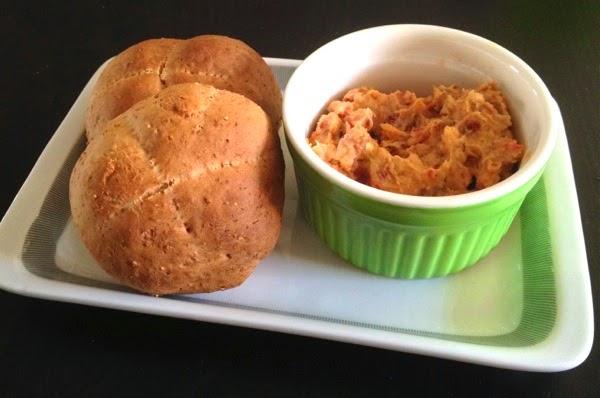
Foodie Friday: Sun-dried tomato cheese spread


The kids love cheese, but we've been getting a little tired of the usual cheese sandwiches (which we've been eating a lot since we have co-ops to attend twice a week). So I've been trying to make our own spreads, and the kids love this version with sun-dried tomatoes. I was taught how to make this when we were staying in Germany, and its really easy to make! The spread is savoury and sweet, with a tang of tomatoes, and hubs and I love the extra kick from the chilli. 

Ingredients:
7 dates, pitted
6 sun-dried tomatoes
1 small onion
1 large chilli
Cream cheese, 200g

Steps:
1. Add dates, tomatoes, onion and chilli into the blender/food processor. Blend.
2. Add cream cheese, and blend to mix. And that's it! (I told you it was easy!)

Since the kids can't really take spicy food, I usually omit the chilli when preparing the spread. I then scoop out half of the spread into a container, and then blend the chilli into the remaining spread inside the blender. It does mean the chilli might turn out a little chunkier than the other ingredients, but we're fine with it. 

I'm on the hunt for other cheese-based spreads to make, so if you have any good recipes at hand, please do share! 

Linking up with:

Friday, June 13, 2014

Foodie Friday: Durians


When I was young, my parents would sometimes buy durians at the market when they were in season. We would then sit at a bench nearby, and feast upon the creamy fruit, licking up the littlest remains on our fingers. My mum would usually bring part of the shell back, fill it with salt water, and make us drink from the shell, in the hope that the water would "balance" the "heatiness" from the durian. I loved those times, sitting down, eagerly waiting while my mum would split apart the shell to reveal the golden yellow flesh within, while sniffing the strange smell which some loathe, while some love.


It was durian season when we visited Penang last week. The boys caught many glimpses of the king of fruits, being sold on the windy roads coming back from Batu Ferringhi, and spotted the thorny fruits hanging up in the trees. And they got to taste it when my in-laws bought some. 

Junior J drew this after he ate some of the durian. This is his diagram of the digestive system,
complete with a stomach, small intestine and large intestine, with some durian in it. 

I was really hoping that the boys would like it. Durian gives me a sense of family, from all those times our family feasted on the fruit together. One fruit usually yields way too much for one person to eat, so it is a fruit that fosters companionship. Ironically, the hubby ate way too much durian in his childhood, and now dislikes the taste and smell of it.

And the kids? Lil J, being the little foodie that he is, loved it, and kept coming back for more:


Junior J ate some, and this was his initial reaction:


He took some more after that, but I think he isn't too enthusiastic about it, and prefers mangosteens. Whatever the case, I do dream of times in the future when we can sit together and feast on these fruit, just like how we did years ago!  

Linking up with:

Friday, May 30, 2014

Dinner is a family affair (and why I won't be eating fish for awhile)


We recently invited my parents for dinner, and the whole family got roped in to help! This round, Junior J wanted to write the menu on sheets of paper, so I wrote the names of the dishes on a piece of paper, he copied it, and we clipped them to a clipboard (something we spotted at a cafe a couple of days back). He was extremely proud of his menu!

Here's what we ate that night:

:: Fish in a Bag: We ate something similar at Casa Verde previously and the kids loved it! I chanced across this Jamie Oliver recipe when I was browsing for ways to cook fish, and we decided to cook it for my parents. However, we steam it instead, since it seems to cook faster. Hubby usually does the fish, since I'm not good at cooking fish, and he does a fantastic job.


:: Sun-dried Tomato Basil Pasta: This is a hit with the family, and it is remarkably easy to prepare since you only need to cook the pasta and blitz the other ingredients in a blender. (Note: We substitute orzo with fusilli, and use the oil used for soaking the tomatoes instead of olive oil. And because the tomatoes and oil are already salty, we do not add any salt or cheese.)


:: Zoodles with Creamy Avocado Sauce: We recently bought a spiral vegetable slicer from Amazon and have been experimenting with it (disclaimer: this is an affiliate link). Thus far, we've mainly made zoodles (zucchini noodles) using the slicer, but I'm hoping to try it with sweet potatoes, or make our own curly fries. It's basically a gadget where you fix the veggies to a holder, turn the handle, and the veggies are sliced into spirals. Ours has 3 blades that slices the vegetables into flat "noodles", or spaghetti-like ones of two different thickness. The one we are using was recommended by another blogger, and is simple enough for a 2 year old to operate: 

Thus far, he has been making all our zoodles.
Usually one quarter of what he cranks out goes into his tummy,
even before it reaches the dinner table!

We eat the zoodles raw. I found the avocado sauce a tad too sour, and we'll probably use half a lemon next time, instead of an entire lemon. Otherwise, the sauce does add a nice tang to the zoodles!


We had a lovely dinner together! The only unfortunate thing was that while I was almost done with dinner, I accidentally swallowed a small fish bone (you know how we mothers tend to gulp down our dinner because there's always some kid to attend to?). So we spent the last part of dinner trying to get the bone out. It was quite funny, since we were all sitting around eating, while hubby was poking at me with a chopstick while I aimed his handphone light into my mouth so he could see. He thought it was embedded in my tonsil, so we ended up having to make a trip to the A&E (with baby in tow, while my parents ended up having to babysit the two older boys at home). The doctor examined me, and after quite a bit of literal tongue-pulling and a scope, declared he couldn't spot the bone, and recommended a CT scan. By then I couldn't really feel my throat from the anaesthesia, so we decided to take a chance and go home and monitor, in the hope that the bone had dislodged itself and gone down! 

I am really thankful for good and patient doctors, and I take my hat to all the ENT doctors. Having to spend the day helping people, while they gag and cough and make strange noises at you, is certainly not an easy task! And I think this incident has put me off eating fish for awhile!

Linking up with:

LinkWithin

Related Posts Plugin for WordPress, Blogger...